
Sprzeciw against the nakaz zapłaty
With the sprzeciw (objection) you tell the court that you do not agree with a nakaz zapłaty (payment order) issued in the postępowanie upominawcze (reminder procedure) or in the EPU (electronic reminder procedure). The law does not require reasons.
Deadline
You have two weeks from the day the order was served on you in Poland (art. 480² § 2 KPC), not from the date printed on it. If the order was served abroad, a longer period applies; the period that applies is always printed in the order. How to count is explained on the page Deadline.
What the sprzeciw must contain
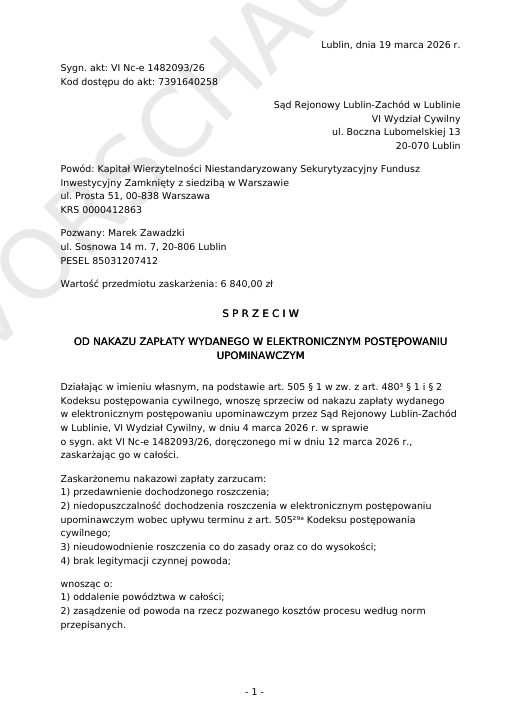
There is no compulsory official form; an ordinary letter is enough. It names the court and its division (wydział), the sygnatura akt (case number) exactly as printed in the order, in the EPU also the access code, your name, address and PESEL, the claimant, the word "sprzeciw", and whether you challenge the order in full or in part. It is signed by hand.
No reasons are required (art. 480³ § 2 KPC). But formal objections, for example that the court lacks jurisdiction, must be raised before you engage in a dispute on the merits, otherwise they are lost. In practice it helps to state your objections.
Free of charge, no evidence in the EPU
No court fee is payable for a sprzeciw. In the EPU no evidence is attached to the sprzeciw (art. 505³⁵ KPC); only the copy for the claimant goes with it.
In full or in part
The order loses its force only in the part you challenge (art. 505 § 2 KPC). The rest becomes final and enforceable. If you agree, for example, with the principal but not with interest and fees, you can challenge only those and state the amount. If there are several debtors, the sprzeciw of one of them affects only that person; each files for themselves.
Standard objections in our sprzeciw
Our sprzeciw contains objections prepared by a lawyer. You tick those that fit your case; we do not choose for you.
- Przedawnienie (limitation): claims against a consumer are time-barred after three years, ending on the last day of the calendar year (art. 118 KC). After that, a claim against a consumer cannot be enforced, and the court takes this into account of its own motion (art. 117 § 2¹ KC).
- The EPU three year rule: in the EPU a claim may be pursued only if it became due no earlier than three years before the claim was filed (art. 505²⁹ᵃ KPC).
- Nieudowodnienie (claim not proven): the claimant has not shown either the basis or the amount of the claim.
- Brak legitymacji czynnej (no standing): where a debt buyer sues, it must prove both the assignment and that it covered exactly your debt. In the EPU no evidence is attached to the claim, so this objection carries particular weight.
Ways of filing
- By post: handing the letter in at a Poczta Polska post office (or at the universal postal service in another EU country) counts as filing with the court (art. 165 § 2 KPC), even on the last day. Send it by registered post (list polecony) and keep the receipt.
- In person at the court's filing office (biuro podawcze): ask for a stamp on your own copy.
- In the EPU also electronically through the e-sad.gov.pl portal.
- Not by e-mail.
The sprzeciw goes to the court that issued the order, together with one copy (odpis) for the claimant.
What happens next
Ordinary reminder procedure: the order loses its force in the challenged part and the case continues as ordinary court proceedings, in which you can present your evidence.
EPU: the order loses its force in the challenged part and the court discontinues (umarza) the proceedings in that part (art. 505³⁶ KPC). The case is not transferred to your local court. If the creditor wants to continue, it must file a new ordinary claim; if it does so within three months, the effects of the EPU claim, including the interruption of limitation, are preserved (art. 505³⁷ § 2 KPC). Each party bears its own costs of the EPU proceedings (art. 505³⁷ § 1 KPC).
What Catius Documents prepares
From your details we create a sprzeciw ready to sign, as PDF and Word, for printing and sending by post, with the copy for the claimant.
39 zł including VAT, one-off.
No subscription, no hidden fees.
No legal advice
Catius Documents does not assess your case in law and does not represent you. For a large amount or if you are unsure, also consult a lawyer (adwokat or radca prawny).